Diving into the Real-World with Robotic Systems: Optimization Computing Challenges in Learning and Adaptation in a Real-world
College of Control Science and Engineering
Zhejiang University
Abstract:
Autonomous robotic inspection in harsh environments (forests, underground spaces, nuclear
plants and caves) faces tough challenges in real-time planning, robust perception and
efficient optimization. This talk introduces a suite of field-verified multi-modal robotic
solutions from ZJU FAST Lab that connect theoretical optimization advances to real-world
deployment.
We present TOP, a GPU-parallel trajectory optimization method achieving near-constant
computation time for fast quadrotor navigation in dense wild spaces. FLAP, an FOV-aware
active perception planner, enables safe mapless 3D exploration by incorporating risk metrics
and LiDAR viewing constraints. We further propose PIDAO, a physics-inspired PID optimizer
rooted in mechanical dynamics, offering stable convergence for robot learning and large
model training with open-source implementations. We also discuss LLM-driven robot pipelines
for natural language command parsing and autonomous exploration.
Our systems have been deployed for forest inventory, nuclear facility inspection and cave
exploration. We conclude with unresolved challenges including fluid-robot coupling,
multi-robot coordination and edge real-time optimization for next-generation robust
inspection robots.
Keywords: robotic asset inspection; UAV trajectory optimization; active perception;
physics-based optimizer; field robotics
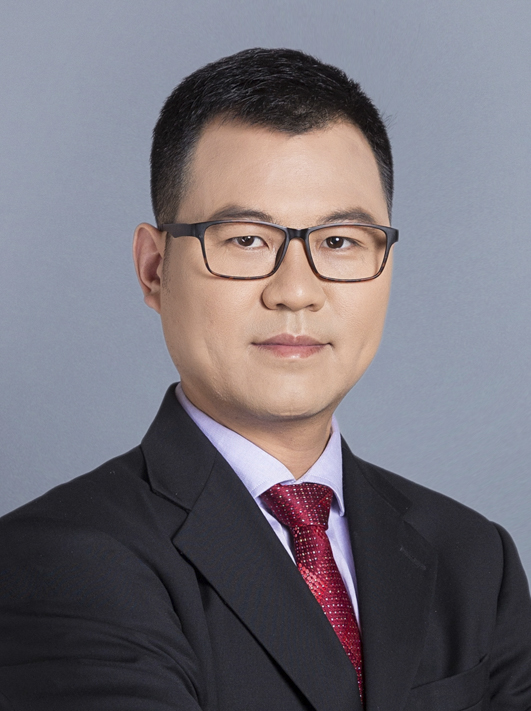 Chao Xu is a Professor and doctoral supervisor at the College of Control Science and
Engineering, Zhejiang University, as well as Director of Zhejiang University Huzhou
Institute. He founded FAST Lab and Propulsion Innovation Lab (π Lab) at Zhejiang University.
Focusing his research on Physical & Embodied Intelligence, he conducts interdisciplinary
investigations centered on deep-learning control architectures and intelligent robotic
control frameworks.
Chao Xu is a Professor and doctoral supervisor at the College of Control Science and
Engineering, Zhejiang University, as well as Director of Zhejiang University Huzhou
Institute. He founded FAST Lab and Propulsion Innovation Lab (π Lab) at Zhejiang University.
Focusing his research on Physical & Embodied Intelligence, he conducts interdisciplinary
investigations centered on deep-learning control architectures and intelligent robotic
control frameworks.
Dr. Xu is selected as a leading talent of Zhejiang Provincial Ten-Thousand Talents Program
and received the Frontier Science Award at the 2024 International Conference on Fundamental
Science. He has led the formulation of IEEE international standards for intelligent UAVs.
His swarm robotics developments were exhibited in the national Forging Ahead in a New Era
achievement showcase and have been permanently collected by the National Museum of China.
His research outputs have been featured by mainstream media including CCTV and Science and
Technology Daily. He has published a series of high-impact works in top-tier journals such
as Science Robotics, Nature Machine Intelligence and Nature Communications, and has
consecutively been included in Elsevier's ranking of the World's Top 2% Scientists.
He currently serves as Director of Zhejiang Provincial Concept Verification Center for
Logistics Equipment AI and Embodied Intelligence, and Director of Zhejiang Provincial
Engineering Research Center for Intelligent Mobile Unmanned Systems. He holds editorial
appointments as Managing Editor of the SCI journal Journal of Industrial and Management
Optimization, as well as the founding Executive Editor-in-Chief of the ESCI publication IET
Cyber-Systems & Robotics.